In a world with more extreme weather events, climate resilience
matters for a city’s competitiveness, not just its ability to attract multinationals,
technology, and talent. Repeated flooding raises insurance costs, water scarcity disrupts
industrial production, and extreme heat delays outdoor work and increases fire risks — all
constraints on business activity. Companies must consider whether cities are investing in
resilience against weather-related business disruption as well as improving livability and
workability.
The challenges are especially acute for the world’s developing
cities, where rapid growth strains infrastructure. Over 85% of cities whose population
growth doubled during the past five years were in developing countries, including cities
such as Angola’s Luanda and Ethiopia’s Addis Ababa. Companies will need to assess how lack
of investment in resilience impacts business opportunities in such cities, or what measures
can be taken to mitigate the risks.
Weather disruptions
Exhibit that shows how more than 85% of rapidly expanding cities are in developing
countries.
85%
of rapidly expanding cities are in developing countries,
where growth is outpacing infrastructure and increasing business risk
$100 billion
Global insured climate losses exceeded $100 billion for
the fifth year in a row in 2024
Some are investing, but many aren’t
Business leaders will find plenty of climate leaders. Paris, for
example, aims to ensure that every resident is within a seven-minute walk of a “cool island,”
such as a park or open-air pool, and plans to install solar panels on priority buildings by
2030. Miami has issued climate bonds to fund the installation of water
pumps, new flood barriers, and the elevation of roadways. Singapore has responded to flood risks by widening drains, raising
ground levels, and building water detention tanks.
Examples are not limited to developed cities. Dhaka is investing in
flood barriers and has appointed a city heat officer, all of which support companies
investing in the city’s manufacturing. Freetown has planted over 1 million trees to reduce landslide risks
during floods and to provide shade and water catchment areas.
Cities will need the right levels of governance and capital to prepare for extreme weather or risk higher insurance and borrowing
costs. Extreme weather events, such as flooding or droughts, also could trigger
internal migration, adding to population pressures in more resilient cities, particularly in
developing markets. CEOs will need to consider these risks, especially as they enter new
cities or expand their footprint.
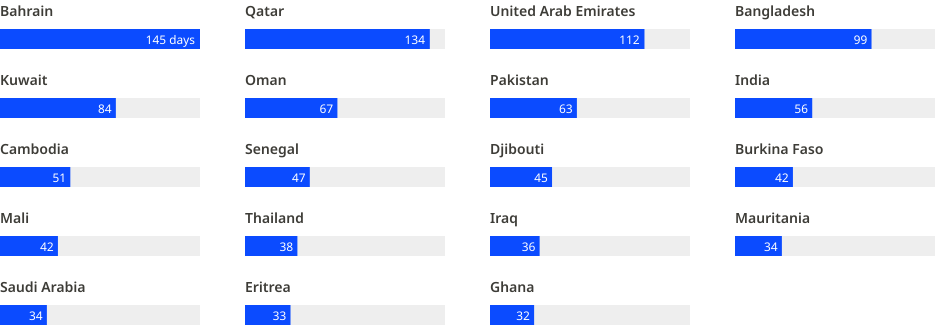
World's hottest countries
Total count of days per year where the daily mean
Heat Index rose above 35 degrees C. (2018-20 average)
Source: World Bank Group;
Oliver Wyman Forum analysis
Flood risks threaten manufacturing, especially outside of
China
The world’s supply chains are equally exposed to climate risks, with
many manufacturing hubs in flood-prone or water-scarce areas. Over 40 of Asia’s top 100
manufacturing cities have high flood risks, according to our data. Ho Chi Minh City,
Dongguan, Jakarta, Shanghai, and Chennai, for example, suffer periodic flooding following
storm surges, and leading companies conduct regular risk assessments before investing or
signing up new suppliers.
Companies cannot assume this is only a developing market challenge.
Manufacturing hubs in Europe and the United States also experience flooding, although they
are more often exposed to inland river flooding. Industrial areas in Liege and San Antonio,
for example, suffered significant flooding in the last five years. Nevertheless, the
challenges are most acute for developing markets, as factories are more likely to be located
near coastal ports where shipping exports are easy, making them more exposed to coastal
events.
Chinese cities have an opportunity to lead. The country is exposed
to higher climate risks than many developed countries, but sustainability investments in
places like Shenzhen, which has a triple dyke coastal defense system, may persuade
manufacturers to stay in China rather than diversify to lower-cost countries. China's investments in renewables technology, such as water recycling
systems, also protect against the water scarcity that will challenge other less
developed competitors.
Climate change challenges livability and talent attraction
Climate resilience and livability are key to attracting and
retaining the world’s best employees, from architects to AI engineers. Talent may migrate
from cities affected by excess heat and humidity, frequent floods, or water shortages to
areas with milder climates, more resilient infrastructure, and easy access to natural
surroundings and activities like hiking, cycling, and skiing — a consideration for companies
seeking to attract workers.
The challenges are especially acute for cities in the tropics, such
as Chennai or Manila, where extreme heat, flooding, and typhoons regularly occur. Of the
1,500 cities analyzed, 281 are in tropical areas. On average, they rank 500 places lower in
our Climate Resilience index than other cities in the index. That implies higher adaptation
costs and greater risks to business should the frequency of extreme weather events worsen.
Middle East cities provide examples of how to respond. Extreme heat
and arid conditions make summers especially challenging and a potential deterrent to talent.
But the adoption of smart cooling systems and reflective materials are just some of the
approaches used in cities like Riyadh to ensure buildings are sufficiently cooled. Urban
planners also are creating more canopies and green “pocket spaces” to improve walkability.
Distribution of top 250 cities in our climate
rankings, by region and ranking tier
Source: Oliver Wyman
Forum